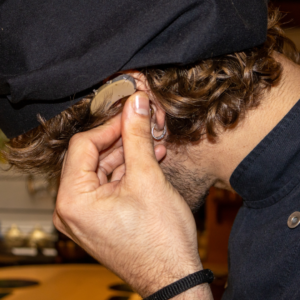
Restaurant conversations can be challenging when background noise makes it difficult to focus on speech. Our specialists can evaluate your hearing in both quiet and noisy listening environments to better understand why busy settings may be particularly difficult for you. Once we identify the factors contributing to your listening difficulties, we can recommend solutions tailored to your specific hearing and communication needs.
Understanding the Difference Between Hearing in Quiet and Restaurant Noise
Quiet environments typically offer a favorable signal-to-noise ratio, meaning the speaker’s voice is much louder than the surrounding sounds. Restaurants can create the opposite acoustic environment. Conversations from nearby tables, background music, clattering dishes, and reverberation can interfere with speech clarity, requiring your brain to work harder to identify and follow the person speaking.
Difficulty understanding speech in noisy environments can be associated with high-frequency hearing loss, central auditory processing difficulties, or age-related changes in the auditory system. Poor lighting, listening fatigue, and sitting farther away from conversation partners can make communication even more challenging.
Some people may have relatively normal results on a standard hearing test but still experience significant difficulty understanding speech in noisy environments. If restaurants and other busy settings consistently make conversations challenging, a comprehensive hearing evaluation can help identify potential contributing factors.
Clinical Evaluation for High-Frequency Hearing Loss
Your evaluation begins with a discussion of your communication concerns and hearing history. We may also ask about noise exposure, tinnitus or ringing in the ears, medications, and whether your hearing difficulties affect one or both ears.
Pure-tone audiometry measures the softest sounds you can hear across a range of frequencies using air- and bone-conduction testing. People with high-frequency hearing loss may have a sloping audiogram, showing reduced sensitivity to higher-pitched sounds. Depending on your symptoms, additional testing may include tympanometry to evaluate middle-ear function and word-recognition testing to assess speech understanding.
Because a quiet hearing booth cannot fully recreate the challenges of a busy restaurant, speech-in-noise testing can provide additional insight. This testing evaluates how well you recognize words or sentences as the level of background noise increases. Results can help determine whether your difficulty is primarily related to audibility, speech clarity, processing competing sounds, or a combination of factors.
How Can Auditory Processing Difficulties Affect Hearing in Adults?
Auditory processing difficulties can affect how the brain interprets and organizes sounds after they are detected by the ears. Someone may have relatively normal peripheral hearing but still struggle to separate a speaker’s voice from competing sounds, distinguish speech details, or follow rapid conversations.
Our clinical team first evaluates your peripheral hearing. Based on your medical history and initial test results, we can determine whether additional auditory-processing testing or consultation with another specialist may be appropriate.
Practical Strategies for Improving Speech Understanding in Noise
Simple changes to your surroundings and communication habits can make conversations easier to follow in noisy environments. When dining out, consider choosing a quieter restaurant or visiting during an off-peak time. Restaurants with upholstered seating, carpeting, curtains, acoustic treatments, and other soft surfaces may be easier to hear in than spaces with predominantly hard surfaces.
Communication Strategies While Dining Out
- Choose a table away from kitchen entrances, busy bar areas, overhead speakers, and large groups.
- Sit with your back against a wall to reduce distracting sounds coming from behind you.
- Face the person you are speaking with and choose a well-lit location to make it easier to use visual cues.
- Sit closer to your conversation partners to improve access to their voices.
- Position your better-hearing ear toward the person you most need to understand.
- Ask someone to rephrase a sentence when you miss the meaning instead of simply repeating it.
- Confirm important information rather than guessing when speech is unclear.
- Take a short break from conversation when listening fatigue begins to build.
- Ask conversation partners to speak clearly and at a natural, comfortable pace.
- Avoid shouting. Speaking louder does not always make speech easier to understand and may sometimes reduce clarity.
What Tools Can Help With Hearing in Background Noise?
The most appropriate technology depends on the cause of your hearing difficulties, the environments where you struggle, and whether measurable hearing loss is present.
Modern hearing aids may use directional microphones, digital noise-management features, and personalized settings designed to improve access to speech in challenging listening environments. However, no hearing device can completely eliminate background noise or competing conversations.
Remote microphones can provide additional support when distance or background noise makes conversations difficult. These devices can be placed near or worn by the person speaking and transmit their voice directly to compatible hearing aids or wireless receivers, helping improve the signal-to-noise ratio.
Other assistive options may include:
- Table microphones designed for group conversations
- Telecoil technology for compatible hearing-loop systems
- Smartphone apps that provide real-time speech transcription
- Wireless earbuds with speech-enhancement features
- Sound-level or venue-finding apps that can help identify quieter dining environments
Our team can help you compare appropriate technologies, check device compatibility, and learn how to use your hearing equipment effectively.
Clinical Audiology Care for Hearing in Complex Noise
A comprehensive hearing evaluation goes beyond determining whether you can hear sounds in a quiet testing environment. We consider the specific listening situations that are challenging for you, including restaurants, group conversations, and other noisy environments, and select diagnostic tests accordingly.
Your evaluation may include pure-tone hearing testing, middle-ear testing, word-recognition testing, and speech-in-noise measures. Additional central auditory-processing testing may be considered when your history and initial results suggest that further evaluation is appropriate.
If you experience sudden, asymmetric, or rapidly worsening hearing loss, seek prompt medical evaluation from an ear, nose, and throat physician.
Personalized audiology care can help identify factors contributing to difficulty hearing in complex environments and guide you toward appropriate solutions.
Schedule a Hearing Evaluation
If dining out leaves you guessing at words, struggling to participate in conversations, or feeling exhausted from trying to listen, a comprehensive hearing evaluation can help.
Our team can evaluate your hearing in the context of your everyday listening needs and discuss options that may include hearing aids, assistive listening technology, and communication strategies.
Contact our practice today to schedule a consultation and take the next step toward more comfortable conversations in restaurants and other social settings.
